US Dollar - USD
- Turkish Lira - TRY
- US Dollar - USD
- Euro - EUR
- Pound sterling - GBP
- Russian Ruble - RUB
- Chinese Yuan - CNY
- Georgian lari - GEL
- Saudi Riyal - SAR
- UAE Dirham - AED
- Syrian Pound - SYP
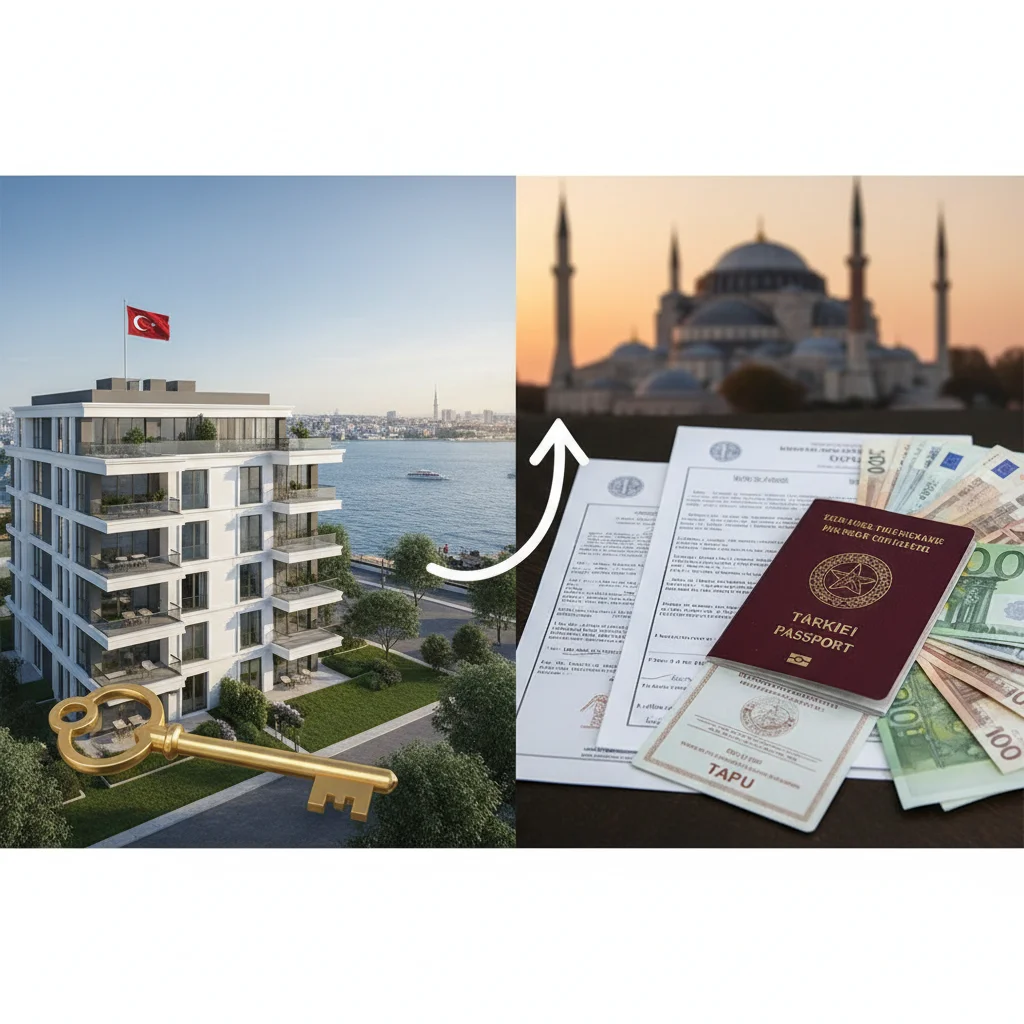
Turkey has positioned itself at the crossroads of Europe, Asia, and the Middle East not only geographically, but also as one of the most accessible destinations for global property investors seeking a second passport. In 2026, the country’s Citizenship by Real Estate Investment program continues to attract buyers from across the globe who want tangible asset ownership paired with long-term mobility, business access, and family security.
Unlike programs that rely on non-refundable government donations or complex venture capital commitments, the Turkish pathway lets you retain full ownership of a hard asset—residential or commercial real estate—while securing citizenship for yourself and your immediate family. Once the mandatory three-year holding period ends, you remain free to sell the property, hold it for ongoing rental income, or pass it on to future generations.
Navigating the process successfully requires more than simply wiring funds and signing a deed. Regulatory updates over recent years have tightened appraisal controls, currency conversion rules, seller eligibility checks, and short-term rental compliance. Understanding these mechanics before you reserve a unit can save you months of delays and protect your capital.
Introduced in 2017 and refined several times to strengthen transparency and market integrity, Turkey’s real estate citizenship route grants full Turkish nationality to foreign buyers who acquire qualifying property worth at least $400,000 USD (or the equivalent in foreign currency). Unlike standard naturalization, which requires five years of continuous physical residence and Turkish language proficiency, the investment track has no minimum stay requirement and no language test.
Citizenship granted through property investment carries the exact same rights and obligations as citizenship by birth. You receive a Turkish national identity card and passport, the right to live, work, and study anywhere in Turkey without visas or work permits, access to Turkey’s public healthcare and education systems, and the ability to vote. Turkey also permits dual citizenship, meaning you do not have to renounce your existing nationality unless your home country prohibits holding two passports.
To qualify for Turkish citizenship via property acquisition in 2026, the main applicant must satisfy the following statutory conditions:
A single $400,000 investment covers the principal investor as well as eligible nuclear family members under the same application file:
Parents of the main applicant and unmarried adult children over 18 without qualifying disabilities cannot be included directly under the citizenship application. However, once you obtain citizenship, or even prior to that through separate residency routes, family reunification residence permits can often be arranged for elderly parents depending on current immigration regulations.
Many delays in Turkish citizenship files happen because buyers assume the market price on a developer’s brochure automatically satisfies government thresholds. In practice, three distinct numbers must align: the official appraisal value, the bank transfer amount reflected on the Currency Exchange Certificate, and the declared value on the Title Deed. If any of these falls short of $400,000, the Ministry will reject the Certificate of Conformity.
You are not restricted to buying a single luxury residence. Turkish law allows investors to combine two or more properties—such as two mid-market apartments in different districts or a residential unit paired with a commercial office—to reach the $400,000 minimum. All properties must be registered under the same buyer’s name, and each must carry the three-year non-sale annotation.
Investors can also qualify using off-plan or under-construction properties through a notarized Promise to Sell Contract (Satış Vaadi Sözleşmesi). For this route to work, the project must have already established construction servitude (Kat İrtifakı), the full $400,000+ contract price must be paid in advance before notarization, and the contract must be annotated at the Land Registry.
To prevent artificial recycling of the same apartments among foreign buyers, the General Directorate of Land Registry and Cadastre enforces strict rules regarding both the asset and the seller.
The property you buy cannot belong to a foreign national, nor can it belong to a foreign-owned company or a Turkish company in which foreign individuals hold significant controlling shares (except under narrow corporate exceptions tied to approved development projects). Furthermore, the property must not have been transferred from a foreign citizen to a Turkish citizen within the past three years, and it must never have been used previously by another investor to apply for Turkish citizenship.
Residential apartments, villas, commercial shops, offices, and serviced residences with proper zoning and title structures (Kat Mülkiyeti or Kat İrtifakı) remain the standard choice. Bare agricultural land or raw plots without approved construction plans face severe restrictions and are generally unsuitable for citizenship applications unless paired with valid development permits and non-agricultural zoning classifications. Additionally, properties located inside restricted military or security zones cannot be sold to foreign nationals.
Under Central Bank of the Republic of Turkey (CBRT) regulations, foreign buyers cannot simply pay a Turkish seller in cash or settle the price directly in dollars without converting through a bank. Before the Title Deed transfer takes place, you must transfer your foreign currency (typically USD or EUR) into a Turkish bank account and instruct the bank to sell that foreign currency to the Central Bank for Turkish Lira specifically for a real estate purchase.
The bank then issues a Döviz Alım Belgesi (DAB)—the Currency Exchange Certificate—which lists your passport number, the exact foreign currency amount, the Turkish Lira equivalent, and the property’s parcel details. The Turkish Lira proceeds are then transferred to the seller’s account, and bank receipts stamped by the bank must be submitted alongside the DAB.
Simultaneously, an independent real estate valuation report (Gayrimenkul Değerleme Raporu) must be ordered through the centralized government valuation portal. Independent appraisers licensed by the Capital Markets Board (SPK) are randomly assigned to inspect the property and verify that its fair market value meets or exceeds $400,000. Direct private hiring of an appraiser chosen by the developer or broker is no longer accepted for citizenship transactions.
Looking for the best real estate investment opportunity in Istanbul?
We help you choose the right property based on your budget and goals
Get a Free Consultation
When properly coordinated by an experienced real estate lawyer and advisor, the entire journey from selecting a property to holding your Turkish passport typically takes between four and eight months. Below is the exact sequence of actions required in 2026.
| Process Stage | Responsible Authority | Estimated Timeframe |
|---|---|---|
| Tax ID, Bank Account, and Legal Due Diligence | Tax Office / Turkish Bank / Legal Counsel | 1 – 2 Weeks |
| Centralized Valuation Report and DAB Issuance | SPK Appraiser / Turkish Bank | 1 Week |
| Title Deed (Tapu) Transfer with 3-Year Annotation | General Directorate of Land Registry (TKGM) | 3 – 5 Business Days |
| Certificate of Conformity (Uygunluk Belgesi) | Ministry / Land Registry Foreign Affairs Desk | 2 – 4 Weeks |
| Investor Residence Permit (Article 31/j) | Presidency of Migration Management | 2 – 3 Weeks |
| Citizenship Review, Approval, and Passport Issuance | Population and Citizenship Directorate | 3 – 6 Months |
Budgeting solely for the $400,000 purchase price is a common mistake. Buyers should reserve an additional 5% to 7% of the property value to cover closing taxes, government fees, translations, and professional representation. Remember also that transaction taxes and government fees do not count toward your $400,000 investment threshold.
| Cost Item | Standard Rate / Estimate (2026) | Notes for Citizenship Buyers |
|---|---|---|
| Title Deed Transfer Tax (Tapu Harcı) | 4% of declared Tapu value | Legally split 2% buyer / 2% seller, though buyers often negotiate or pay 4% on resale units. |
| Value Added Tax (VAT / KDV) | 0% to 20% (depends on property type) | Exemption available on first-hand developer sales if paid in foreign currency by non-residents and held for 3 years. |
| Revolving Fund Fee (Döner Sermaye) | Approx. $350 – $650 USD | Fixed administrative fee levied by the Land Registry for foreign transactions. |
| SPK Valuation Report | Approx. $300 – $500 USD | Paid via the centralized government assignment system prior to Tapu transfer. |
| Notary, Translation, and Apostille Costs | $1,000 – $2,000 USD | Varies by family size and number of civil status documents requiring sworn Turkish translation. |
| Compulsory Earthquake Insurance (DASK) | $50 – $200 USD annually | Legally mandatory before Tapu transfer and utility connections. |
| Legal Advisory and Citizenship Filing Fee | $3,500 – $6,500 USD | Covers due diligence, Tapu representation, residency, and full family citizenship filing. |
One significant financial advantage for qualifying international buyers is the VAT exemption under Article 13/i of the Turkish VAT Law. If you purchase a newly constructed property directly from a developer, have not lived in Turkey for more than six months in the preceding year, bring the purchase funds from abroad in foreign currency, and commit not to sell the property for three years (up from one year in earlier rules, aligning neatly with the citizenship hold), you may qualify for a 0% VAT rate—saving between 10% and 20% on brand-new residential or commercial units. Always verify your residency status before signing, as holding a pre-existing Turkish residence permit can disqualify you from the VAT exemption.
Once you own the property, ongoing carrying costs in Turkey remain relatively modest compared to Western Europe or North America. Annual municipal property tax (Emlak Vergisi) typically ranges between 0.1% and 0.2% of the municipal tax value for residential properties (higher in metropolitan municipalities), and up to 0.4% for commercial units. Apartment complexes also charge monthly building maintenance dues (Aidat), which vary widely from $40 per month in standard buildings to several hundred dollars per month in luxury gated compounds with pools, gyms, and 24-hour security.
Choosing the right city and neighborhood determines both your rental yield during the three-year lock-in period and your resale liquidity once the annotation is lifted. Turkey is not a single monolithic market; each major region offers distinct risk-return characteristics.
Accounting for the largest share of foreign property purchases, Istanbul remains Turkey’s economic, financial, and cultural powerhouse. With major infrastructure projects—such as expanded metro networks, the Istanbul Finance Center in Ataşehir, and ongoing urban transformation—demand for modern, earthquake-compliant housing remains strong.
Antalya has evolved from a seasonal resort town into a year-round international hub, supported by an expanding international airport and strong demand from European, CIS, and Middle Eastern buyers. Districts like Lara, Konyaaltı, and Belek attract buyers seeking seaside villas or resort-style apartments. Note, however, that certain neighborhoods with high foreign population density remain closed to new general residence permit registrations; while this does not prevent property ownership or citizenship filings, it can affect the profile of long-term foreign tenants.
Ankara, the nation’s capital, offers remarkable price stability driven by diplomats, civil servants, universities, and defense-sector professionals, making it a strong choice for conservative investors focused on predictable long-term leases. Meanwhile, Izmir—along Turkey’s Aegean coast—appeals to tech professionals, lifestyle migrants, and domestic upper-middle-class buyers, particularly in districts like Karşıyaka, Bornova, Urla, and Çeşme.
Looking for the best real estate investment opportunity in Istanbul?
We help you choose the right property based on your budget and goals
Get a Free Consultation
Acquiring the property and receiving your passport is only half of the investment cycle. Because you must hold the asset for at least three years, how you manage the unit during that period directly impacts your net return.
In Turkey, standard long-term residential leases typically run for one year and automatically renew unless proper legal notice is given under Turkish Code of Obligations protections. Historically, annual rent increases for residential renewals were capped at 25%, a temporary emergency measure that expired in mid-2024. In 2026, annual rent renewal increases are once again governed by the official 12-month Consumer Price Index (TÜFE) average, allowing landlords better protection against inflation.
If you plan to list your apartment on platforms like Airbnb or Booking.com for stays under 100 days, be aware of Turkey’s strict Tourism Purpose Rental Law (Law No. 7464). To legally operate a short-term rental, you must obtain a tourism rental permit plaque from the Ministry of Culture and Tourism—and for apartments inside multi-unit buildings, you must submit unanimous (100%) written consent from all unit owners in the building. Operating an unlicensed short-term rental carries steep administrative fines. Consequently, unless you purchase an entire standalone villa or a licensed serviced residence managed by a hospitality operator, long-term annual leasing is generally the smoother, fully compliant strategy.
Managing a Turkish property remotely without local support can be challenging due to language barriers, municipal paperwork, and tenant laws. Working with a dedicated property management firm allows you to delegate:
Once three full years have passed from the date the annotation was placed on your Tapu, you can apply to the Land Registry to remove the non-sale restriction. Selling the property after year three does not revoke your Turkish citizenship or affect your family’s passports.
However, you should plan your sale timeline carefully around Turkish Capital Gains Tax (Değer Artış Kazancı) rules:
In addition, remember that while you can sell to any buyer after three years, selling directly to another citizenship-seeking foreigner may involve restrictions if the law prohibits reusing the exact same property for a second citizenship application. Targeting domestic Turkish buyers or non-citizenship foreign investors typically ensures the widest resale market.
Even well-funded buyers run into avoidable hurdles when they rely solely on informal sales pitches instead of independent legal verification. Watch out for these frequent pitfalls:
If you finance part of the purchase through a mortgage, only the unencumbered cash equity you pay out of pocket counts toward the $400,000 threshold. Because foreign buyers face low loan-to-value caps in Turkey anyway, nearly all citizenship purchases are completed in cash.
No. There is no minimum physical residency requirement either before or after receiving your Turkish passport. You can remain based anywhere in the world while keeping your Turkish citizenship active.
If you obtain Turkish citizenship at age 22 or older, you are generally exempt from compulsory military service. Male dependents who acquire citizenship as minors may be subject to military service rules upon reaching military age unless they qualify for deferment, paid exemption (Bedelli Askerlik), or exemption based on prior service in another country with reciprocal recognition.
Yes. You can combine an apartment and a shop or office, provided each unit meets legal title and seller requirements, all valuations and DAB transfers add up to at least $400,000, and all deeds carry the three-year non-sale annotation.
Because the threshold is pegged in US Dollars, the Central Bank exchange rate on the day you execute the DAB determines the exact Turkish Lira amount recorded on your Title Deed. You should always leave a small buffer—such as transferring $405,000 to $410,000—to ensure exchange rate spreads or bank fees never pull your net converted value below $400,000.
Sources: Information in this article was sourced from Emlak Platform, Mbany Real Estate, and Massar Istanbul.