US Dollar - USD
- Turkish Lira - TRY
- US Dollar - USD
- Euro - EUR
- Pound sterling - GBP
- Russian Ruble - RUB
- Chinese Yuan - CNY
- Georgian lari - GEL
- Saudi Riyal - SAR
- UAE Dirham - AED
- Syrian Pound - SYP
In 2026, Turkey remains one of the most strategic destinations for Egyptian families and investors seeking a second citizenship, regional mobility, and a resilient real estate asset. With direct flights connecting Cairo and Alexandria to Istanbul in just over two hours, shared cultural traditions, and deep commercial links across the Eastern Mediterranean, acquiring a Turkish passport through property investment offers far more than travel convenience. It provides a practical pathway to asset diversification, educational access, and long-term family security.
Navigating the legal, financial, and property selection steps requires accurate, up-to-date information. Over recent years, Turkish authorities have tightened valuation oversight, currency conversion compliance, and property eligibility rules to protect both the housing market and genuine foreign buyers. This guide breaks down everything Egyptian buyers need to know in 2026, from qualifying thresholds and document legalization in Cairo to rental management and post-citizenship exit strategies.
For Egyptian entrepreneurs, medical professionals, corporate executives, and retirees, holding a Turkish passport serves as both an economic hedge and a lifestyle upgrade. Unlike traditional residency-only programs in Southern Europe that require lengthy physical stays and multi-year naturalization waits, Turkey grants full citizenship directly upon completing a qualifying investment and passing security checks.
Looking for the best real estate investment opportunity in Istanbul?
We help you choose the right property based on your budget and goals
Get a Free Consultation
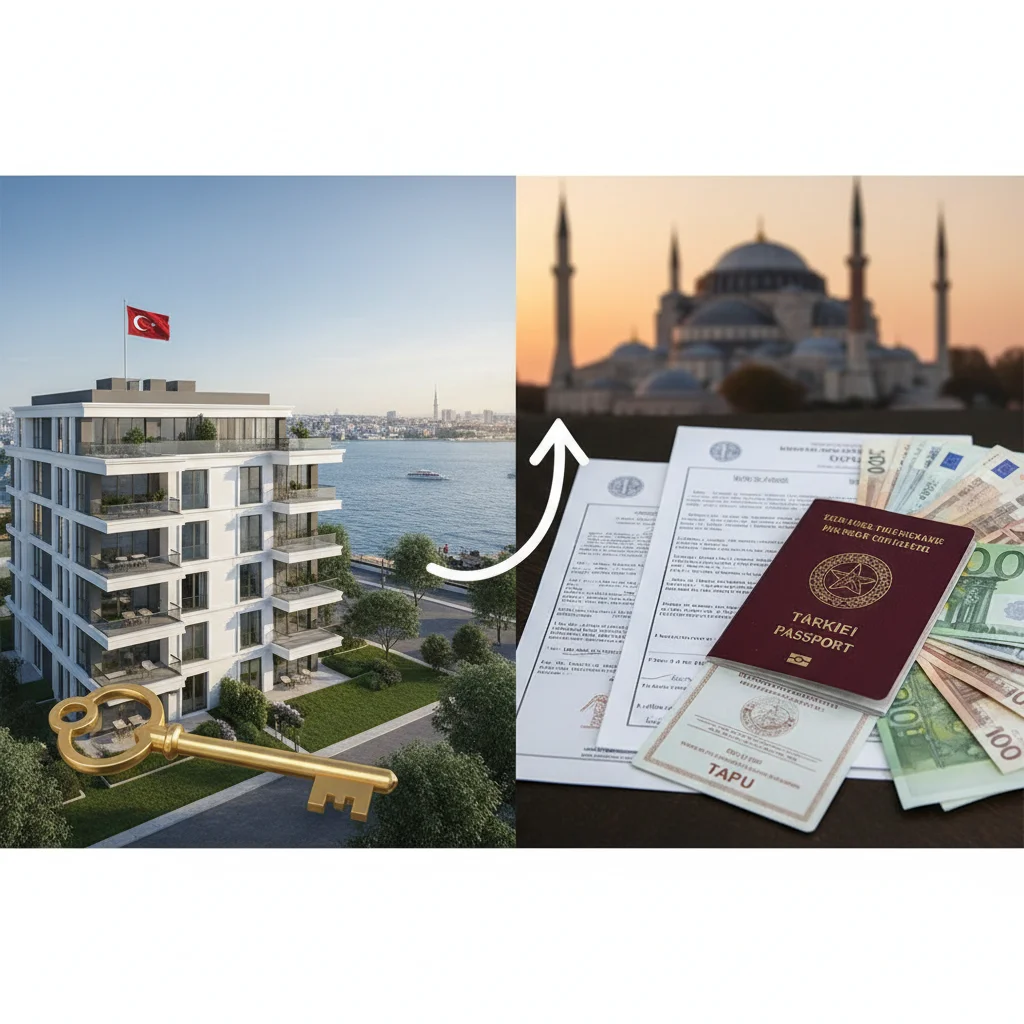
Under the Turkish Citizenship Law framework active in 2026, the primary real estate route requires acquiring one or more properties with a combined official value of at least $400,000 USD. Investors must commit to holding the property without selling it for a minimum period of three years, a restriction officially recorded as an annotation on the title deed.
One of the most critical compliance steps in 2026 is the Foreign Exchange Purchase Certificate. Before the title deed transfer takes place, the Egyptian buyer must transfer the foreign currency (typically USD or EUR) into a Turkish bank account and convert the full purchase amount into Turkish Lira via a Turkish commercial bank acting on behalf of the Central Bank of Turkey. The bank then issues this official certificate, which links the exact currency conversion directly to the buyer's passport number and the specific property parcel. Without this document, the Land Registry will not process a citizenship-eligible transfer.
Before arriving in Turkey—or prior to issuing a Power of Attorney to a Turkish real estate lawyer—Egyptian applicants should prepare their personal civil documents carefully. Every official document issued in Egypt must follow a strict chain of authentication to be accepted by Turkish ministries:
Note that while Turkey allows dual citizenship freely, Egyptian nationals acquiring a second nationality should submit an official notification and permission request to the Egyptian Ministry of Interior's Passports, Immigration, and Nationality Administration to legally retain their Egyptian citizenship without administrative complications.
Not every Egyptian buyer is immediately ready to commit $400,000. Many families begin by exploring property-based residency permits before upgrading their portfolio to meet the citizenship threshold. Understanding the distinction between short-term real estate residency and direct citizenship prevents costly planning mistakes.
In 2026, qualifying for a standard real estate residency permit requires purchasing a residential property valued at a minimum of $200,000 USD in a neighborhood that is open to new foreign registrations. Certain high-density districts across Istanbul and Antalya remain closed to first-time residency permits, though those neighborhood restrictions do not apply to the $400,000 citizenship-by-investment program.
| Program Feature | Property Residency Permit | Citizenship by Real Estate | Citizenship by Bank Deposit |
|---|---|---|---|
| Minimum Investment | $200,000 USD | $400,000 USD | $500,000 USD |
| Mandatory Holding Period | Continuous ownership during permit | 3 years (recorded on title deed) | 3 years (locked deposit) |
| Neighborhood Restrictions | Must be in an open district | None (all legal districts eligible) | Not applicable |
| Family Coverage | Spouse and children under 18 | Spouse and children under 18 | Spouse and children under 18 |
| Work Rights in Turkey | Requires separate work permit | Full unrestricted work rights | Full unrestricted work rights |
| Average Processing Time | 4 to 8 weeks | 4 to 7 months | 4 to 6 months |
| Path to Passport | After 5 years of continuous stay | Immediate upon approval | Immediate upon approval |
Whether you travel to Turkey in person or appoint an independent Turkish attorney via a notarized Power of Attorney at the Turkish Embassy in Cairo, the acquisition and citizenship filing follow a structured sequence.
Your first administrative task is obtaining a Turkish Tax Identification Number, which can be generated online or at a local tax office using your passport. With a tax number in hand, you can open a personal Turkish bank account—a prerequisite for executing the Central Bank currency conversion. Many Egyptian buyers appoint an independent lawyer at this stage to conduct legal due diligence on their behalf and handle municipal registrations.
Once you select one or multiple properties totaling at least $400,000, an official appraisal must be ordered through the centralized government valuation portal. Independent appraisers licensed by the Capital Markets Board inspect the unit and issue an official report.
After verifying the appraisal report, you transfer the funds from your Egyptian or international account to your Turkish bank account, convert the funds into Turkish Lira for the Foreign Exchange Purchase Certificate, and wire the exact purchase price to the seller's bank account. Every transfer receipt must clearly display the sender, recipient, and property details. Both parties—or their legal representatives—then appear at the Land Registry Directorate to sign the transfer and place the mandatory three-year non-sale annotation on the deed.
With the title deed, bank receipts, appraisal report, and currency conversion certificate finalized, your lawyer submits the dossier to the Ministry of Environment, Urbanization, and Climate Change. Once verified, the ministry issues the Certificate of Conformity, confirming that the investment legally qualifies for Turkish citizenship.
Using the Certificate of Conformity, the main applicant first obtains a special short-term Investor Residency Permit. Immediately afterward, the full citizenship dossier—including legalized Egyptian civil documents and security clearances—is submitted to the Directorate General of Population and Citizenship Affairs. Once background checks conclude, the Presidential approval is issued, and Egyptian applicants can register their fingerprints and collect their Turkish ID cards and passports either in Turkey or at the Turkish Embassy in Cairo.
| Process Stage | Primary Authority | Estimated Timeline (2026) |
|---|---|---|
| Tax ID, Bank Account & Due Diligence | Tax Office / Commercial Bank | 3 to 7 business days |
| Official Property Appraisal Report | Licensed Valuation Firm | 5 to 10 business days |
| Title Deed Transfer & 3-Year Pledge | General Directorate of Land Registry | 3 to 5 business days |
| Certificate of Conformity | Ministry of Environment & Urbanization | 2 to 4 weeks |
| Investor Residency & Citizenship Review | Migration & Population Directorates | 3 to 5 months |
Looking for the best real estate investment opportunity in Istanbul?
We help you choose the right property based on your budget and goals
Get a Free Consultation
Choosing the right asset matters just as much as obtaining the passport. Because your capital will be locked into the property for at least three years, selecting a location with strong tenant demand and healthy resale liquidity is essential.
Istanbul continues to attract the vast majority of Egyptian buyers due to its massive domestic rental market, international business ecosystem, and direct air links to Cairo.
Districts such as Başakşehir and Kayaşehir remain deeply popular among Egyptian families thanks to spacious apartment layouts, gated family compounds, proximity to Istanbul Airport, and large medical complexes. Meanwhile, Maslak, Kağıthane, and Zeytinburnu appeal to yield-focused investors targeting corporate tenants, university students, and Bosphorus-adjacent luxury living. Beylikdüzü and Bahçeşehir offer lower price-per-square-meter entry points, allowing buyers to acquire multiple apartments under a single $400,000 portfolio.
On the Anatolian side, Ataşehir has cemented its role as Turkey's premier financial hub following the expansion of the Istanbul International Financial Center. Kadıköy and Üsküdar attract affluent buyers seeking walkable neighborhoods, upscale cafes, and enduring capital preservation, while Pendik and Kartal offer modern coastal towers with strong appeal for mid-to-upper-income professionals.
Turkish regulations permit combining multiple properties to reach the $400,000 minimum, provided all units are declared under the citizenship commitment simultaneously. Some Egyptian investors split their budget between two $200,000+ residential apartments—living in one and renting out the other—while others purchase a single commercial retail unit or office floor leased to an established corporate tenant on a multi-year contract. Commercial properties often deliver higher net yields and require minimal landlord intervention for interior maintenance.
Smart investors always budget beyond the $400,000 property purchase price. Transaction taxes, legal fees, and mandatory insurance typically add between 5% and 8% to the total capital outlay, depending on whether you qualify for foreign-buyer Value Added Tax exemptions.
| Expense Category | Standard Rate / Cost (2026) | Notes for Egyptian Buyers |
|---|---|---|
| Title Deed Transfer Fee | 4% of declared value | Legally split 2% buyer / 2% seller, though buyers often negotiate or cover it with developers |
| Value Added Tax (VAT) | 1% to 20% (Exemptions available) | First-time foreign buyers paying in foreign currency from abroad may qualify for 0% VAT on new developer builds |
| Official Valuation Fee | $350 to $600 USD | Paid through the official appraisal system |
| Revolving Fund Land Fee | ~$150 to $300 USD | Standard administrative fee for foreign title deed transactions |
| Legal Representation | $3,500 to $7,500 USD | Covers due diligence, title transfer, conformity, residency, and citizenship filings |
| Translation, Notary & DASK | $600 to $1,200 USD | Includes compulsory earthquake insurance and sworn translations |
Important note on VAT exemptions: If you purchase a brand-new property directly from a Turkish developer and bring the full purchase price into Turkey in foreign currency from abroad, you may qualify for a complete VAT exemption. However, properties purchased under this exemption carry a restriction prohibiting resale for one year (which easily aligns with the three-year citizenship lock-up). Always verify VAT status in writing before signing a sales contract.
Once your Turkish citizenship is granted, managing your real estate efficiently ensures your asset works for you rather than becoming an administrative burden from Cairo.
Long-term residential leases in prime Istanbul and Ankara neighborhoods typically generate gross annual yields between 4.5% and 7.5%, while commercial properties can deliver 6.5% to 9%. Under Turkish tenancy law, annual rent increases on existing residential leases are tied to the official 12-month Consumer Price Index average, providing a built-in inflation adjustment mechanism.
If you intend to operate your apartment as a short-term vacation rental (leases under 100 consecutive days), be aware of Turkey's Tourism Purpose Rental Law. Owners must obtain an official permit from the Ministry of Culture and Tourism, display a special plaque at the entrance, and secure unanimous written consent from all apartment owners in the building. For remote Egyptian landlords, long-term annual leases or fully serviced branded residences with existing hospitality management licenses are usually far smoother to operate.
Exactly three years from the date the annotation was placed on your title deed, your lawyer can file a simple request at the Land Registry to lift the non-sale restriction. Doing so does not revoke your Turkish citizenship or affect your family's passports in any way. You are free to hold the asset indefinitely, refinance it, or sell it to either a Turkish citizen or another foreign buyer.
However, pay close attention to Turkish capital gains tax rules before selling right at the three-year mark. Under Turkish tax law, capital gains from selling real estate are taxed on an inflation-adjusted progressive scale if sold within five years of acquisition. If you hold the property for five full years from the title deed date, any profit earned upon sale is 100% exempt from personal capital gains tax.
Avoiding costly mistakes comes down to independent verification rather than relying solely on sales promises:
Yes. Turkey permits dual and multiple citizenships without requiring you to renounce your Egyptian nationality. On the Egyptian side, citizens are required to notify and obtain formal permission from the Egyptian Ministry of Interior to retain their Egyptian citizenship when acquiring a foreign nationality.
From the moment you complete your property transfer and submit your legalized Egyptian documents, the entire process—covering the Certificate of Conformity, Investor Residency, security clearances, and Presidential approval—typically takes between 4 and 7 months.
No. Unlike ordinary five-year naturalization routes, the Citizenship by Investment program has no language test, no civic interview exam, and no minimum physical residency requirement in Turkey.
Yes. You can combine two or more residential or commercial units across one or multiple cities, provided all properties meet eligibility rules, have official appraisals totaling at least $400,000, and are submitted together under the three-year citizenship commitment.
Information in this guide was sourced from Emlak Platform, Mbany Real Estate, and Massar Istanbul.