US Dollar - USD
- Turkish Lira - TRY
- US Dollar - USD
- Euro - EUR
- Pound sterling - GBP
- Russian Ruble - RUB
- Chinese Yuan - CNY
- Georgian lari - GEL
- Saudi Riyal - SAR
- UAE Dirham - AED
- Syrian Pound - SYP
The Turkish Citizenship by Investment Program (TCIP) stands out as one of the world's most accessible, resilient, and dynamic direct-citizenship initiatives. Established under the Turkish Citizenship Law No. 5901 and revised across subsequent legislative decrees, the framework enables high-net-worth individuals, global property investors, and international families to secure a Turkish passport within months. With Turkey positioned strategically at the crossroads of Europe, the Middle East, and Central Asia, securing citizenship unlocks profound commercial advantages, geographic mobility, and a secure lifestyle hedge in an increasingly fragmented global economy.
In 2026, the regulatory architecture governing naturalization through economic contribution emphasizes strict compliance, verified foreign currency conversion, accredited valuation standards, and seamless administrative processing. Whether you are driven by portfolio diversification, premium residential living in Istanbul or coastal Antalya, tax structuring, or international travel convenience, navigating the legal, financial, and procedural steps requires an analytical, well-informed approach.
Foreign investors have multiple routes to qualify for naturalization through capital commitments. The Turkish Directorate General of Migration Management (GÖÇ İdaresi) and the General Directorate of Land Registry and Cadastre (Tapu ve Kadastro Genel Müdürlüğü) coordinate closely to evaluate applications across distinct asset classes.
The real estate pathway remains the overwhelming favorite, capturing over 80% of all investment-based citizenship approvals. To qualify:
Investors preferring passive liquidity over brick-and-mortar assets can pursue several sovereign-backed financial alternatives:
Corporate entities and international entrepreneurs can qualify by founding or expanding an enterprise in Turkey that creates verified, full-time employment for at least 50 Turkish citizens. This pathway requires formal certification from the Ministry of Labour and Social Security.
Looking for the best real estate investment opportunity in Istanbul?
We help you choose the right property based on your budget and goals
Get a Free Consultation
Choosing the correct investment vehicle involves assessing capital liquidity, expected yield, holding costs, and long-term asset appreciation. The following table highlights the critical dimensions across all qualifying routes in 2026:
| Investment Category | Minimum Capital (USD) | Holding Commitment | Overseeing Authority | Primary Benefit |
|---|---|---|---|---|
| Residential & Commercial Real Estate | $400,000 | 3 Years | Ministry of Environment, Urbanization and Climate Change | Rental yield, capital growth, and physical utility |
| Turkish Bank Deposit | $500,000 | 3 Years | Banking Regulation and Supervision Agency (BDDK) | High-rate fixed returns and institutional liquidity |
| Sovereign Government Bonds | $500,000 | 3 Years | Ministry of Treasury and Finance | Guaranteed principal with regular coupon yields |
| Real Estate / VC Funds (GYF/GSYF) | $500,000 | 3 Years | Capital Markets Board of Turkey (SPK) | Diversified institutional asset exposure |
| Direct Job Creation | 50 Full-time Employees | 3 Years | Ministry of Labour and Social Security | Operational market access and commercial leverage |
Securing Turkish citizenship via property acquisition requires executing sequential transactions with utmost legal precision. Bypassing compliance protocols can result in delays or formal rejections.
The journey begins long before the transfer of ownership. International buyers must secure a Potential Tax Number (Vergi Kimlik Numarası) from the Turkish Revenue Administration, which can be accomplished online or in person. Simultaneously, foreign buyers must open a commercial bank account within Turkey to handle foreign transfers and currency conversions. Engaging independent legal counsel under a structured Power of Attorney (Vekaletname) drafted before a Turkish notary or Turkish consulate abroad ensures that transactions proceed smoothly in the investor’s absence.
Identifying eligible real estate is paramount. Under current regulations, properties purchased for citizenship must not have been used previously by another foreign applicant to obtain citizenship. Crucially, the investor must commission an independent valuation report from a licensed real estate appraisal company accredited by the Capital Markets Board (SPK). This report verifies that the real-world market value equals or exceeds the $400,000 USD statutory benchmark.
Foreign funds designated for property purchases must be wired to the investor's Turkish bank account in convertible foreign currencies (USD, EUR, GBP). The Turkish bank then executes a specialized sale of this currency directly to the Central Bank of Turkey (TCMB). The bank issues the formal Döviz Alım Belgesi (DAB), noting the investor's identity, the foreign currency amount converted, and the intended property title deed reference. Without this document, the Land Registry cannot finalize the transaction under the citizenship framework.
Once the funds are remitted to the seller, the Land Registry Office (Tapu Müdürlüğü) executes the title transfer. An official covenant is inscribed onto the registry: "Pursuant to Article 20 of the Regulation on the Implementation of the Turkish Citizenship Law, there is a commitment not to sell this property for three years."
Following the registration of the title deed, the paperwork is submitted to the General Directorate of Land Registry and Cadastre’s Department of Foreigners. Upon validating the title deed, valuation report, and currency exchange certificate, the authority issues the official Certificate of Eligibility. This serves as the sovereign green light for naturalization.
Citizenship applicants must first obtain an expedited investor residence permit under Article 31, Paragraph (j) of the Foreigners and International Protection Law No. 6458. Unlike ordinary tourist residence permits, the 31/J residence permit does not mandate continuous physical presence in the country. It can be issued rapidly through specialized citizenship service desks operated by the Migration Directorate.
With the Certificate of Eligibility and the Investor Residence Permit in hand, the citizenship file is formally lodged. The package includes certified birth certificates, apostilled family status documentation, marriage certificates, health insurance, and passport copies. Turkish intelligence, security, and interior agencies perform comprehensive background checks to confirm that the applicant poses no national security or public order risks. Once approved by Presidential Decree, the applicant and eligible family members visit a local civil registration office (Nüfus Müdürlüğü) or a Turkish embassy abroad to submit biometrics and receive their Turkish ID cards and passports.
Looking for the best real estate investment opportunity in Istanbul?
We help you choose the right property based on your budget and goals
Get a Free Consultation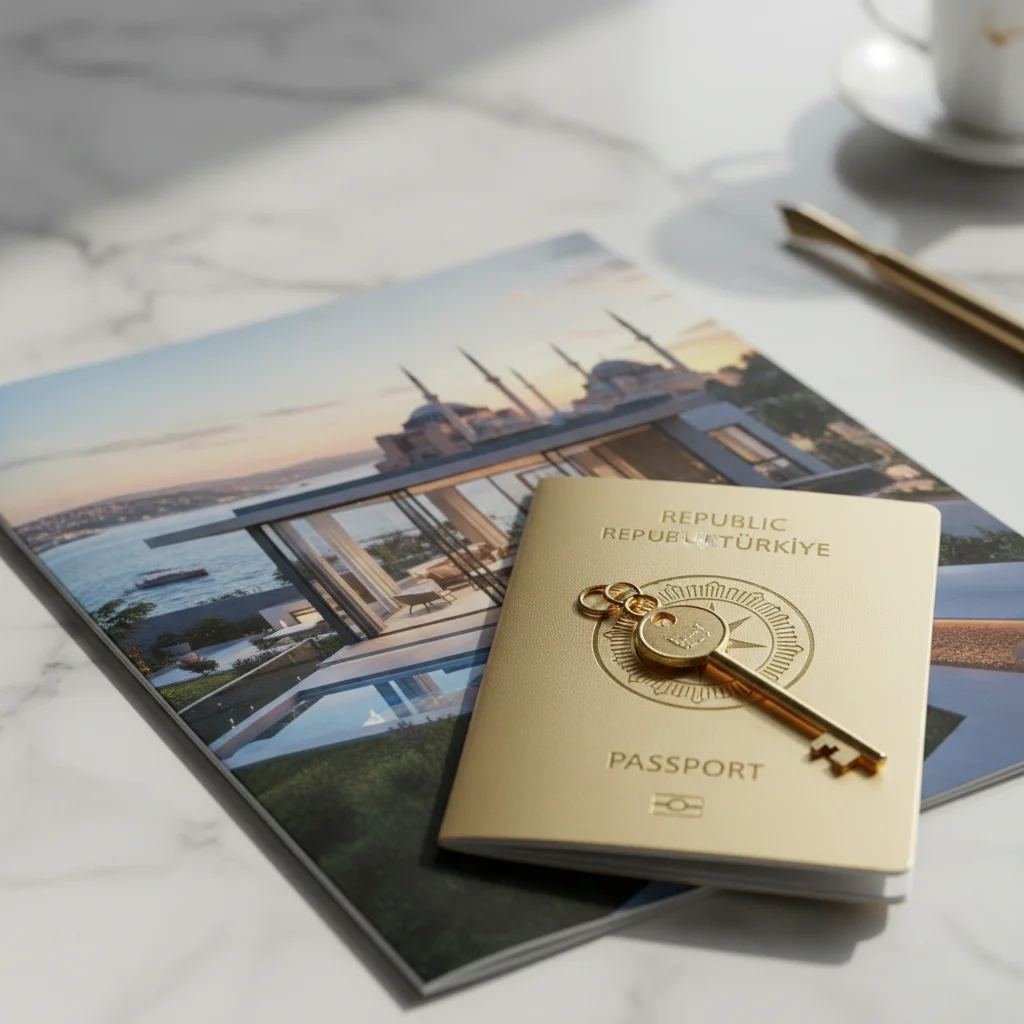
Documentation requires flawless preparation, cross-border legalization, and certified sworn Turkish translation. Any omission or naming discrepancy can interrupt processing times.
While the path to a Turkish passport is straightforward, investors must navigate technical complexities to avoid financial exposure or application denial.
A common error among unrepresented buyers is failing to reconcile the developer's asking price with the independent SPK valuation. If a property is marketed at $420,000 USD but the independent appraiser values the property at $390,000 USD based on local comparables, the transaction falls short of the citizenship threshold. Seasoned real estate advisory ensures that every property contract is explicitly tied to a preliminary appraisal before capital is released from escrow.
Turkish cadastral regulations restrict citizenship applications on properties that were transferred from another foreign national within the prior three years. Furthermore, properties that have already been used to claim Turkish citizenship cannot be recycled for a new applicant. Purchasing directly from a Turkish citizen or an accredited Turkish development company avoids chain-of-title disqualification.
All property values are converted from foreign currency to Turkish Lira (TRY) at the moment the DAB is minted by the Central Bank. Investors must monitor currency spreads and wire slightly above the statutory threshold to shield the transaction against intra-day exchange volatility that could pull the final verified sum below $400,000 USD.
Securing Turkish nationality provides substantial long-term benefits for international investors and their families:
A single real estate investment of $400,000 USD extends citizenship to the principal applicant, their legally recognized spouse, and all children under the age of 18 at the time of final approval. Dependent adult children with documented special needs can also be included. Other relatives, such as parents or adult children over 18, must apply independently through separate investments or obtain standard long-term residency permits.
Turkey fully recognizes dual and multiple citizenship under its legal framework. Foreign nationals naturalized through investment are not forced to renounce their native passports, provided their country of origin allows dual citizenship. Furthermore, individuals who acquire Turkish citizenship via investment past the standard draft age, or who have already completed compulsory military service in their country of origin, are typically exempt from Turkish military obligations.
A Turkish passport provides visa-free or visa-on-arrival access to over 110 destinations globally, spanning Latin America, East Asia, and regional business hubs. Additionally, Turkish citizens benefit from streamlined access to European Schengen business visas and long-standing bilateral trade treaties, providing a sturdy commercial springboard for cross-border enterprises.
Maintaining the asset during the mandatory three-year holding window can transform an administrative investment into a highly profitable real estate play. Property management strategies in core metropolitan hubs like Istanbul, Ankara, and Izmir focus on maximizing net rental yields while safeguarding property condition.
Foreign owners can select between traditional 12-month residential leases yielding steady income in local currency or managed, short-term corporate lets targeted at expatriates and business executives. Prime locations in central Istanbul—such as Maslak, Beşiktaş, Kadıköy, and the Bosphorus corridor—sustain consistent rental demand, frequently providing net yields between 4% and 7% in hard-currency equivalent terms.
Understanding local fiscal commitments ensures comprehensive compliance:
The total timeframe from initial property inspection to receiving your physical Turkish passport generally spans between 3 to 6 months, assuming accurate legal assembly.
| Stage | Primary Action Required | Estimated Timeframe |
|---|---|---|
| Stage 1: Asset Selection | Site visits, price negotiation, legal due diligence | 1 to 2 Weeks |
| Stage 2: Financial Setup | Tax ID, bank account, funds remittance, DAB certificate | 1 Week |
| Stage 3: Title Conveyance | Valuation report issuance, Tapu transfer, 3-year annotation | 3 to 5 Days |
| Stage 4: Eligibility Filing | Cadastral review, issuance of Certificate of Eligibility | 1 to 2 Weeks |
| Stage 5: Investor Residency | Lodge Article 31/J permit, issuance of residence card | 2 to 3 Weeks |
| Stage 6: Citizenship Lodgement | Security vetting, inter-ministerial review, presidential sign-off | 60 to 90 Days |
| Stage 7: Passport Issuance | Biometric data capture, passport printing, courier delivery | 5 to 10 Days |
Once the three-year statutory annotation expires, investors retain complete legal discretion over their property portfolio. The owner can:
By pairing strategic asset acquisition with thorough procedural compliance, foreign investors can secure a prosperous, borderless future under Turkey's well-established legal and real estate ecosystem.
Information in this guide was compiled and verified utilizing industry insights and regulatory publications sourced from Emlak Platform, Mbany Real Estate, and Massar Istanbul.