US Dollar - USD
- Turkish Lira - TRY
- US Dollar - USD
- Euro - EUR
- Pound sterling - GBP
- Russian Ruble - RUB
- Chinese Yuan - CNY
- Georgian lari - GEL
- Saudi Riyal - SAR
- UAE Dirham - AED
- Syrian Pound - SYP
The relationship between the Republic of Turkey and the Republic of Iraq has fostered one of the most dynamic real estate corridors in the Eastern Mediterranean and Middle East. Over the past decade, Iraqi nationals have consistently ranked among the top international buyers of Turkish property. While early cross-border investments were predominantly driven by lifestyle relocations and capital preservation, the contemporary landscape is centered firmly on legal status: acquiring Turkish citizenship through real estate investment.
In 2026, the Turkish Citizenship by Investment (TCBI) program operates under refined statutory standards designed to attract high-caliber foreign direct investment while maintaining rigorous financial due diligence. For Iraqi investors, the program offers a permanent hedge against regional volatility, visa-free access to over 110 destinations, world-class healthcare, high-tier educational institutions, and a liquid real estate market capable of generating sustainable foreign-currency rental yields. However, navigating the bureaucratic, banking, and security vetting processes requires an intimate understanding of both Turkish administrative law and Iraqi documentation frameworks.
Turkish citizenship legislation, anchored primarily in the Turkish Citizenship Law No. 5901 and its implementing regulations, sets forth multiple economic thresholds for exceptional naturalization. For Iraqi investors evaluating capital deployment in Turkey, the options are categorized into distinct asset classes.
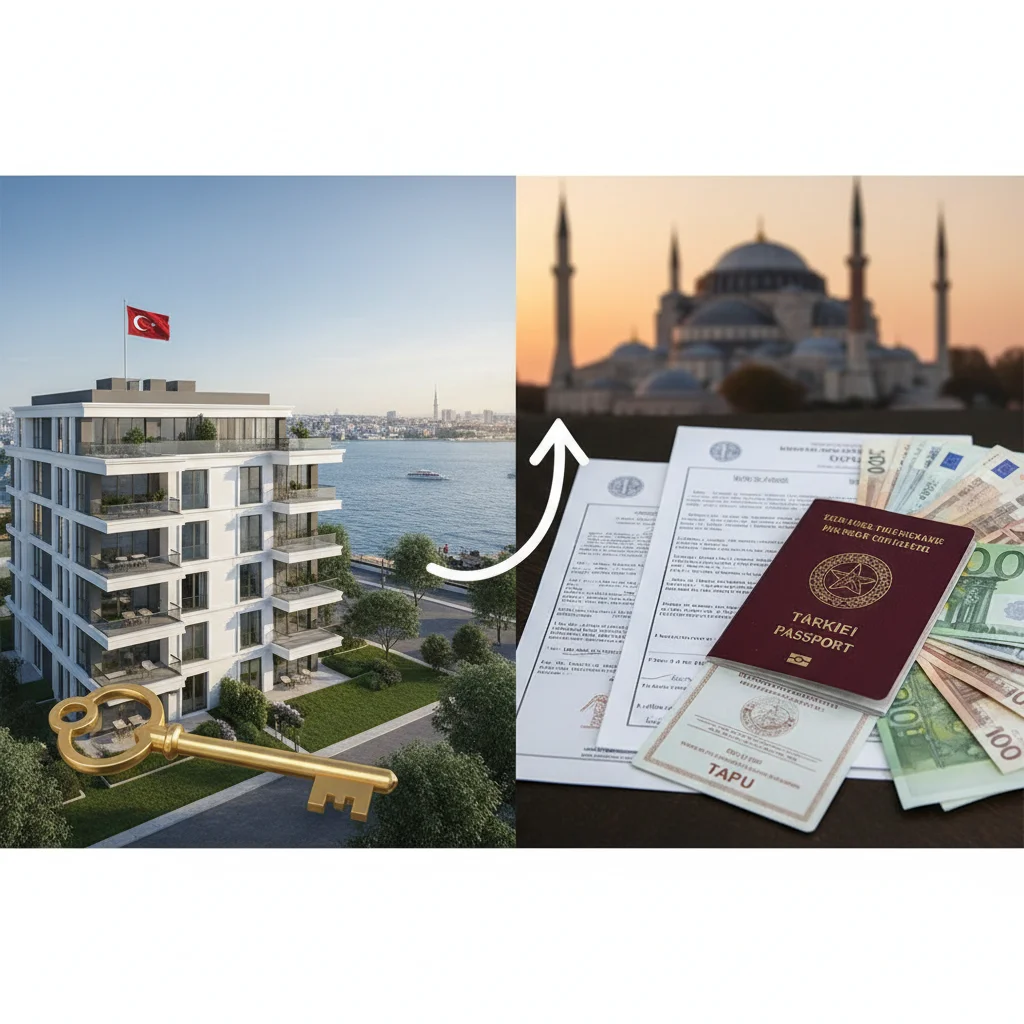
Acquiring real estate remains the primary mechanism utilized by more than 85% of Iraqi applicants. Under current regulatory provisions, foreign nationals who purchase one or multiple properties with a cumulative valuation of at least $400,000 USD (or its equivalent in foreign currency) are eligible for fast-track citizenship. The legal condition mandates placing an annotation (şerh) on the Title Deed (Tapu) at the Land Registry, stipulating that the property cannot be sold or transferred for a minimum period of three years.
For individuals seeking liquid asset placement without direct exposure to brick-and-mortar assets, alternative routes include:
Non-Turkish nationals who establish commercial enterprises employing at least 50 full-time Turkish citizens, certified by the Ministry of Labour and Social Security, qualify directly for naturalization.
Looking for the best real estate investment opportunity in Istanbul?
We help you choose the right property based on your budget and goals
Get a Free ConsultationChoosing between physical real estate acquisition and financial assets depends on liquidity preferences, ongoing return on investment (ROI) goals, and asset management capacity. The comparative matrix below outlines the primary mechanisms:
| Investment Vehicle | Statutory Minimum | Holding Period | Iraqi Banking Complexity | Yield Potential (Annual) | Exit Liquidity |
|---|---|---|---|---|---|
| Residential Real Estate | $400,000 USD | 3 Years | Moderate (SWIFT/DAB required) | 5% – 8% (USD/EUR Indexed) | High (Liquid Secondary Market) |
| Commercial Real Estate | $400,000 USD | 3 Years | Moderate (Direct Bank Transfer) | 6% – 9% (Long-term Corporate Leases) | Moderate to High |
| Turkish Bank Deposit (YUVAM) | $500,000 USD | 3 Years | High (Source-of-Funds Clearance) | Variable Central Bank Interest | Guaranteed Principal upon Maturity |
| Real Estate Investment Funds (REIF) | $500,000 USD | 3 Years | Moderate to High | 8% – 12% (Capital Appreciation + Divs) | High (Regulated Fund Redemption) |
While the statutory thresholds apply equally to all nationalities, the practical execution for Iraqi citizens involves specific regulatory compliance. Historically, Iraq was subject to reciprocal property acquisition treaties; however, following the landmark amendment to Article 35 of the Land Registry Law No. 2644 in May 2012, the reciprocity requirement was abolished, allowing Iraqi nationals to purchase real estate in their personal names without special ministerial permission.
Every foreign property buyer seeking citizenship must comply with the Central Bank of the Republic of Turkey (TCMB) foreign currency protocol. The entire transaction amount must be remitted in foreign currency (USD, EUR, or GBP) to a Turkish intermediary bank. The bank converts this foreign currency into Turkish Lira through the Central Bank’s official system, issuing a Foreign Exchange Purchase Certificate (Döviz Alım Belgesi or DAB).
The DAB must explicitly state the investor’s full legal name, passport number, and the specific real estate parcel details. Title deed transfers cannot proceed without an authenticated DAB registered in the Land Registry information system (TAKBİS).
Moving capital from Iraq to Turkey represents the most sensitive phase of the process. Iraqi buyers must navigate anti-money laundering (AML) protocols and international banking transfer channels (SWIFT). The legal consensus mandates:
All naturalization files undergo rigorous security vetting coordinated by the General Directorate of Civil Registration and Nationality (Nüfus ve Vatandaşlık İşleri Genel Müdürlüğü), in tandem with the National Intelligence Organization (MİT) and the General Directorate of Security (Emniyet Genel Müdürlüğü). For Iraqi nationals, background checks verify that the applicant has no affiliations with sanctioned organizations, no INTERPOL red notices, and no history of violating Turkish immigration statutes.
A structured legal pathway guarantees security of capital and eliminates procedural delays. The standard lifecycle of a Turkish Citizenship by Investment application spans approximately 90 to 120 days from title deed acquisition to passport delivery.
The process initiates by obtaining a Potential Tax Number (Vergi Kimlik Numarası) from the Turkish Tax Authority. With this identification, legal counsel—operating under a notarized Power of Attorney (Vekaletname)—opens a fully compliant corporate/retail bank account for the Iraqi investor in one of Turkey’s major banking institutions (e.g., Ziraat Bankası, Türkiye İş Bankası, Garanti BBVA, or VakıfBank).
Independent legal due diligence is paramount. The investor’s legal team must review the Title Deed at the Land Registry to confirm:
Before purchasing, an independent appraisal must be executed by a valuation firm authorized by the Capital Markets Board (SPK). The appraised fair market value must match or exceed the $400,000 threshold. The valuation data is uploaded digitally to the government portal (WEB-TAPU) to prevent intentional overvaluation.
The investor remits funds from Iraq to their Turkish account, after which the bank converts the foreign exchange to Turkish Lira via the Central Bank window, generating the mandatory DAB document.
At the Land Registry office, the title deed is officially transferred to the Iraqi buyer. Simultaneously, a formal restriction is entered in the registry: "Pursuant to Article 20 of the Regulation on the Implementation of the Turkish Citizenship Law, this property will not be sold for three years from the date of acquisition."
The Land Registry forwards the file to the General Directorate of Land Registry and Cadastre (TKGM) Foreign Affairs Department. TKGM issues the official Certificate of Conformity, verifying that the transaction meets all requirements under the citizenship program.
Armed with the Certificate of Conformity, the investor and their dependent family members submit applications for a specialized short-term residence permit under Article 31/J of Law No. 6458. Unlike ordinary tourist residence permits, the 31/J investor permit does not enforce minimum stay durations and is approved swiftly within 10 to 14 days.
The completed file is submitted to the Special Citizenship Bureau (Özel Vatandaşlık Bürosu). The applicant and dependents provide biometric data (fingerprints) at the local Provincial Directorate of Civil Registration or at the Turkish Embassy in Baghdad or Consulate General in Erbil.
Following successful inter-agency security clearances, the citizenship file is forwarded to the Presidency of the Republic of Turkey. Naturalization is enacted via Presidential Decree. The applicants are then issued Turkish Identity Cards (T.C. Kimlik Kartı) and Turkish Passports.
Looking for the best real estate investment opportunity in Istanbul?
We help you choose the right property based on your budget and goals
Get a Free Consultation
Documentation originating in Iraq requires strict consular attestation because Iraq is not a party to the 1961 Hague Apostille Convention. All Iraqi public documents must complete the chain of legalization: Iraqi Ministry of Foreign Affairs (MOFA) certification, followed by attestation by the Turkish Embassy in Baghdad or the Turkish Consulate General in Erbil.
Iraqi buyers demonstrate distinct geographical preferences based on cultural alignment, capital allocation strategy, and family lifestyle. However, selecting the appropriate sub-market dictates both capital preservation and real capital growth.
Istanbul remains the premier choice for institutional-grade asset selection. Iraqi investors consistently focus on prime transportation corridors and urban regeneration districts:
For investors prioritizing vacation homes paired with high-yield short-term rental models (subject to the Tourism Rental Law passed in early 2024), districts such as Konyaaltı, Lara, and Kepez provide strong entry points. Antalya's property market benefits from uninterrupted multi-national demand, hedging income in EUR and USD.
The Turkish capital presents a stable, counter-cyclical investment environment. Districts like Çankaya and Çayyolu offer stable long-term leases to civil servants, diplomats, and international agencies, offering reliable returns without the price volatility seen in purely speculative zones.
Historically attractive to Iraqi families looking for spacious standalone villas, thermal wellness amenities, and a temperate mountain climate, both Yalova and Bursa offer lower price-per-square-meter metrics while remaining within easy reach of Istanbul via ferry transit networks.
In accordance with the demographic balance regulations established by the Presidency of Migration Management (Göç İdaresi Başkanlığı), foreign residency permits are restricted in neighborhoods where foreign population density has reached 20-25% of the total census. While acquiring a property for citizenship operates under distinct legislation from regular tourist residency permits, purchasing in closed neighborhoods can occasionally complicate address registration (Adres Kaydı / MERNİS).
It is vital that investors verify the current status of the target district via official cadastral listings before entering into binding purchase contracts. In Istanbul, high-density areas such as Fatih, Esenyurt, and specific quarters of Avcılar and Zeytinburnu have statutory restrictions that require specialized legal handling.
The acquisition of citizenship does not mark the conclusion of the investor's legal journey; it initiates the asset-management phase. Because the property is encumbered by the three-year inalienability annotation, establishing professional property oversight guarantees sustained value creation.
Iraqi investors holding real estate in Turkey must remain cognizant of standard fiscal obligations:
The primary hurdle faced by Iraqi nationals seeking Turkish naturalization lies in banking compliance and anti-money laundering (AML) protocols. Turkish banks and regulatory authorities implement heightened due diligence for funds originating from Middle Eastern corridors.
Investors must maintain verifiable records detailing the origin of funds. Acceptable evidence includes:
Iraqi buyers should work exclusively through primary financial networks. Transferring funds through Iraqi private or state-owned banks (such as Trade Bank of Iraq - TBI) via formal international correspondent clearing banks guarantees acceptance by the Turkish Central Bank for the issuance of the DAB. Attempts to bypass formal banking routes through manual cash declarations at Turkish border customs are subject to intense scrutiny and require immediate redepositing into the Turkish banking system with documented customs declaration receipts (Nakit Beyan Formu).
A central advantage of the Turkish citizenship model is its non-confiscatory nature: the underlying capital is not lost or consumed as an administrative fee. Upon the exact expiration of the three-year holding period:
Before committing capital to the Turkish real estate market for citizenship purposes, review this procedural checklist:
Market analysis, statutory frameworks, and cadastral compliance data in this guide were assembled with industry insights sourced from Emlak Platform, Mbany Real Estate, and Massar Istanbul.