US Dollar - USD
- Turkish Lira - TRY
- US Dollar - USD
- Euro - EUR
- Pound sterling - GBP
- Russian Ruble - RUB
- Chinese Yuan - CNY
- Georgian lari - GEL
- Saudi Riyal - SAR
- UAE Dirham - AED
- Syrian Pound - SYP
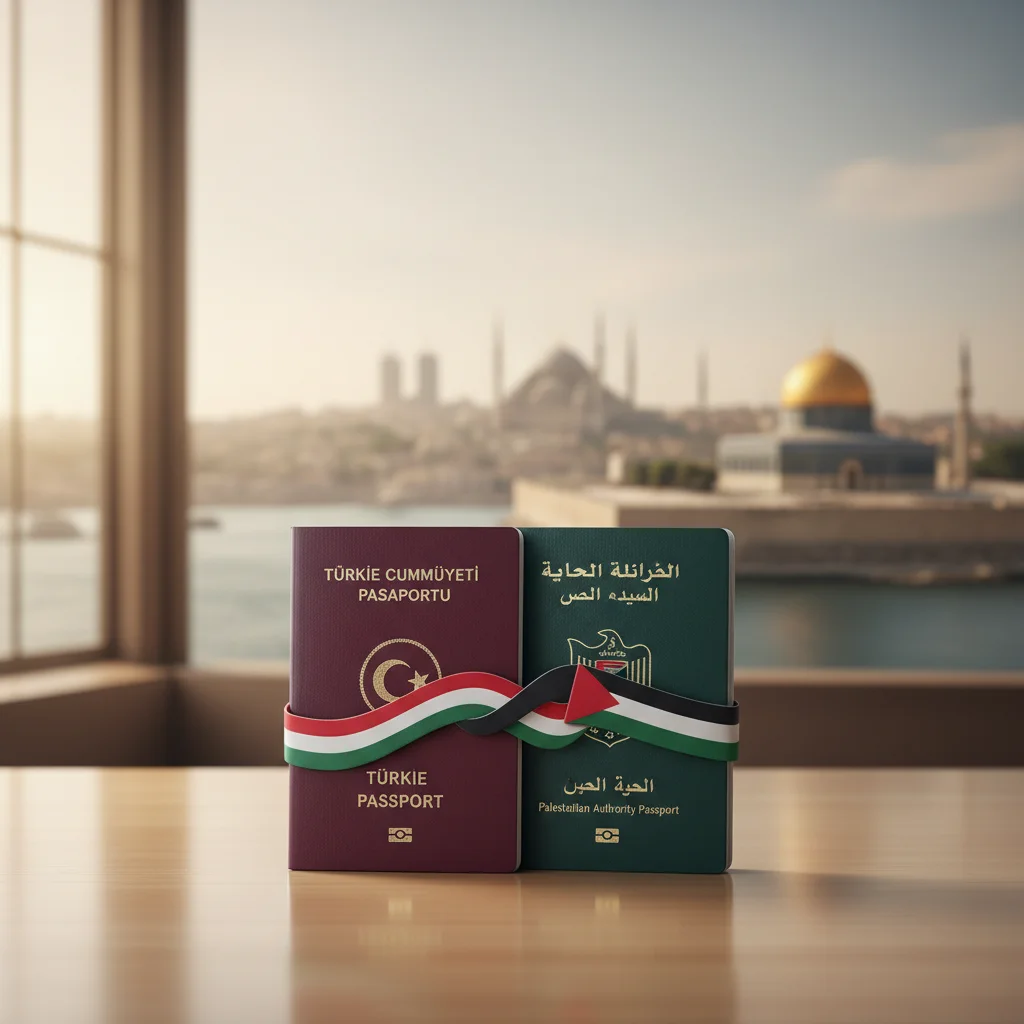
The pursuit of global mobility, asset protection, and generational security has positioned the Turkish Citizenship by Investment (CBI) program as one of the most compelling options for Palestinian investors worldwide. Since the landmark amendments to the Turkish Nationality Law and the abolishment of the reciprocal condition under Title Deed Law No. 6302, foreign nationals—including Palestinians holding various travel documents and passports—have gained clear, institutional avenues to secure full Turkish citizenship. As of 2026, real estate investment remains the most secure, value-accretive, and streamlined mechanism for Palestinian families to obtain a second passport while establishing a resilient financial foothold in Turkey’s dynamic economy.
Securing Turkish citizenship involves far more than simply selecting a property and wiring funds. For Palestinian applicants, unique documentation nuances, cross-border banking protocols, and geopolitical status verifications require meticulous due diligence. Whether you hold a Palestinian Authority (PA) passport, a Jordanian passport with or without a national identification number, or a refugee travel document issued by Lebanon, Syria, or Egypt, understanding the precise procedural requirements under Turkish administrative law is vital to navigating this process efficiently.
Looking for the best real estate investment opportunity in Istanbul?
We help you choose the right property based on your budget and goals
Get a Free Consultation
Unlike standard applicants holding conventional sovereign passports, Palestinian nationals fall into distinct administrative classifications under Turkish immigration law. Turkey’s Directorate General of Migration Management (Göç İdaresi) and General Directorate of Land Registry and Cadastre (Tapu ve Kadastro Genel Müdürlüğü) treat these classifications differently depending on the issuing authority of your travel document.
Palestinians residing in the West Bank or the Gaza Strip carrying passports issued by the Palestinian Authority are legally recognized as foreign nationals capable of acquiring real estate directly under their legal identity. The document is registered within the Turkish land registry system using the formal nationality code for Palestine. Property registration proceeds normally, provided the asset complies with the statutory minimum investment threshold and location restrictions.
A substantial segment of Palestinian investors hold Jordanian travel documents. Turkish administrative law distinguishes between two scenarios:
Palestinians residing across the Levant or North Africa who hold refugee travel documents (Document de Voyage) face specific legal considerations. While historically subject to heightened administrative review, current Turkish regulations allow holders of recognized travel documents to acquire real estate for citizenship purposes, provided they submit certified family records (Nufus extracts), birth certificates authenticated by the issuing country’s Ministry of Foreign Affairs (MOFA), and consular attestations legalized by Turkish diplomatic missions.
---The Turkish Citizenship by Investment program offers multiple investment options under Article 20 of the Regulation on the Implementation of the Turkish Citizenship Law. While several avenues exist, real estate investment remains the overwhelming preference for Palestinian buyers seeking tangible asset ownership and capital appreciation.
| Investment Route | Minimum Statutory Threshold | Holding Period | Primary Advantages | Suitability for Palestinians |
|---|---|---|---|---|
| Real Estate Acquisition | $400,000 USD (or equivalent foreign currency) | 3 Years (annotation on Tapu) | Tangible equity, rental yield, strong capital appreciation, personal residence option | Highest: Directly creates generational real estate wealth |
| Fixed Bank Deposit | $500,000 USD (or equivalent) in Turkish banks | 3 Years (locked under YUVAM system) | Liquid asset, no property management overhead | Moderate: Subject to central bank foreign exchange conversion requirements |
| Capital Investment Fund (REIF / PEIF) | $500,000 USD | 3 Years | Institutional management, tax-advantaged yields | High: Ideal for passive high-net-worth investors |
| Government Bonds | $500,000 USD | 3 Years | Sovereign backing, predetermined returns | Moderate: Lower comparative returns versus real estate |
| Job Creation | Employ at least 50 Turkish citizens | 3 Years operational audit | Direct business expansion into Turkey | Specialized: Tailored for active industrialists and entrepreneurs |
For a Palestinian family, navigating the end-to-end citizenship lifecycle requires a sequenced, legally verified path. Deviations in fund transfers or contract wording can lead to significant administrative delays.
The process begins by appointing an experienced Turkish real estate attorney specialized in nationality law. A Power of Attorney (Vekâletname) can be issued at any Turkish consulate abroad (such as in Ramallah, Amman, Dubai, or European capitals) or at a notary public within Turkey. This document empowers legal counsel to execute title deed transfers, handle currency exchange protocols, and submit citizenship dossiers on your behalf.
Every investor must obtain a Turkish Tax Identification Number (Vergi Kimlik Numarası). Opening an account in a premier Turkish participation or commercial bank (e.g., Ziraat Katılım, Kuveyt Türk, Garanti BBVA) requires:
Not every property in Turkey qualifies for citizenship. The property must satisfy strict statutory conditions:
Under Turkish Central Bank (TCMB) regulations, foreign real estate buyers cannot pay sellers directly in foreign currency. The investor transfers foreign currency (USD, EUR, GBP) to their personal Turkish bank account. The bank converts this amount into Turkish Lira and issues a Foreign Exchange Purchase Certificate (DAB Belgesi) to the Central Bank. The bank then transfers the Turkish Lira equivalent directly to the seller's account.
At the Land Registry Office (Tapu Dairesi), the transfer of ownership is recorded. Crucially, an annotation (Şerh) is placed on the title deed stating that the property cannot be sold or transferred for a minimum period of three years, pursuant to Article 20 of the Citizenship Law.
Once the title deed is issued and the DAB document confirmed, the Land Registry forwards the file to the General Directorate of Land Registry and Cadastre. The authorities issue a formal Certificate of Conformity confirming that the investment meets all legal parameters of the citizenship decree.
Prior to submitting the citizenship application, the primary investor and their family must obtain a specialized short-term residence permit under Article 31, paragraph (J) of the Law on Foreigners and International Protection. Unlike standard touristic residence permits, this investor residency is processed expeditiously through dedicated citizenship bureaus without lengthy queues.
With the residence permit in hand, the complete dossier is submitted to the General Directorate of Civil Registration and Citizenship Affairs (Nüfus ve Vatandaşlık İşleri Genel Müdürlüğü). The file undergoes comprehensive multi-agency background screening, including checks by the National Intelligence Organization (MİT) and the General Directorate of Security (Emniyet Genel Müdürlüğü). Upon clearance, the application is presented to the Presidency of the Republic of Turkey for final decree approval.
Looking for the best real estate investment opportunity in Istanbul?
We help you choose the right property based on your budget and goals
Get a Free Consultation
Document preparation represents the most complex operational phase for Palestinian families. Missing stamps or inconsistent name transliterations can stall applications indefinitely. Every document originating outside Turkey must undergo proper attestation and legalization.
Because Palestine is not a signatory to the Hague Apostille Convention of 1961, documents issued in Palestine cannot be apostilled. Instead, they must follow the diplomatic legalization chain:
For Palestinians holding Jordanian documents, legalization must route through the Jordanian MOFA in Amman and the Turkish Embassy in Amman, or proceed through the Hague Apostille mechanism if eligible under specific Jordanian civil registry conventions.
---Maximizing real estate returns while qualifying for citizenship requires disciplined geographic targeting. Palestinian investors generally prefer a balance of family residential utility and sustainable dollar-pegged rental yields.
Istanbul remains the premier choice for international investors. The city offers diverse sub-markets catering to distinct investment profiles:
Antalya presents an alternative for investors seeking lifestyle assets combined with seasonal rental yields. Neighborhoods such as Konyaaltı and Lara offer stable capital appreciation driven by European, Middle Eastern, and Central Asian demand. However, investors must cross-reference foreign residency quotas, as select micro-districts in Antalya maintain caps on foreign registration.
As the administrative capital, Ankara offers lower entry prices per square meter compared to Istanbul, along with long-term tenant stability from diplomatic, governmental, and university populations. Çankaya and Çayyolu represent the primary districts for high-value residential and commercial assets.
---One of the most critical phases for Palestinian investors is transferring capital to Turkey. International compliance frameworks, including the Financial Action Task Force (FATF) guidelines and US Office of Foreign Assets Control (OFAC) monitors, place heightened scrutiny on cross-border payments originating from the Middle East.
Turkish citizenship is granted for life and extends without restriction to the principal applicant, their legally wedded spouse, and all biological or legally adopted children under the age of 18 at the time of approval. Future children born to the family are automatically granted Turkish citizenship by birth.
| Family Member Category | Direct Inclusion in Application? | Required Accompanying Legal Documents | Post-Grant Processing Options |
|---|---|---|---|
| Principal Investor | Yes (Primary Applicant) | Valid Passport, Proof of Funds, Clean Record | Receives Turkish Identity Card and Passport |
| Spouse (Legally Wed) | Yes (One spouse per investment) | Legalized Marriage Certificate, Birth Certificate | Receives full citizenship concurrently |
| Children Under 18 Years | Yes (Included automatically) | Legalized Birth Certificates, Consent of absent parent (if applicable) | Receive full citizenship concurrently |
| Children Over 18 Years | No (Must qualify independently) | Separate investment application required | Eligible for tourist/work residency; citizenship via independent $400k purchase |
| Parents of Investor / Spouse | No | Not eligible under direct CBI framework | Eligible for long-term familial residency permits based on investor's ownership |
Even seasoned investors encounter hurdles during the Turkish CBI process. Understanding these pitfalls allows you to proactively protect your capital and timeline.
The Risk: You agree to buy a property for $420,000 USD, but the SPK-licensed valuation agency assesses its market value at $385,000 USD. If submitted, your citizenship application will be immediately rejected.
The Strategic Solution: Always make your real estate purchase contract contingent upon an independent SPK valuation matching or exceeding the legal minimum. Never wire the full deposit before reviewing a preliminary assessment report.
The Risk: Arabic names often vary in Latin transliteration across different documents (e.g., "Mohammad" vs. "Muhammed", or "Hussein" vs. "Husain"). Even minor character variations between a birth certificate, passport, and marriage certificate can trigger administrative delays at the Interior Ministry.
The Strategic Solution: Work with an experienced legal translator to ensure every translated document reflects a single, unified spelling across all filings. If discrepancies exist on original government papers, obtain an official Name Equivalence Certificate (İsim Denklik Belgesi) before submission.
The Risk: Acquiring a property previously used for citizenship by another foreign investor, or buying from a developer with foreign shareholders. Turkish law prohibits using the same property twice for CBI eligibility, and properties sold by foreign-owned corporate entities are disqualified.
The Strategic Solution: Have your legal counsel conduct comprehensive title deed registry audits to trace historical ownership chains back to ensure that the asset has never featured in a prior citizenship transaction.
---Obtaining your Turkish passport does not end your real estate journey. Managing your underlying investment over the mandatory three-year holding period—and planning an exit or reinvestment strategy—is vital to maintaining strong portfolio performance.
Yes. Turkey permits holders of recognized travel documents to acquire real estate and pursue citizenship, provided the documents are fully verified, translated, notarized, and accompanied by certified civil registry extracts establishing clear identity and family status.
Yes. You are not restricted to a single property. You can combine multiple residential or commercial units, provided all deeds are submitted simultaneously, verified by SPK appraisal reports, and located within registered cadastre areas that meet the cumulative $400,000 USD mark.
No. The Turkish Citizenship by Investment pathway contains no language proficiency tests, residency duration requirements, or history examinations. Applicants and their families acquire full citizenship without linguistic prerequisites.
Under Turkish Military Law, individuals who acquire citizenship after the age of 22 are exempt from mandatory national military service. Because most primary investors and adult dependents enter the program past this threshold, military obligations do not apply.
Your Turkish citizenship is granted permanently. Once the mandatory three-year holding period is completed and verified, you are legally entitled to sell the real estate asset without any impact on your citizenship or that of your family members.
---For Palestinian investors, the Turkish Citizenship by Investment program represents an empowering pathway to secure global access, financial resilience, and personal safety. Turkey combines strategic geography, historical ties with the Palestinian people, and a robust real estate market, offering far more than just a second passport—it provides a welcoming home base and durable financial security.
By understanding document legalization rules, conducting rigorous property due diligence, and partnering with verified legal professionals, Palestinian investors can successfully navigate this transformative process and secure a lasting legacy for generations to come.
---Information in this guide was compiled with insights and industry data sourced from Emlak Platform, Mbany Real Estate, and Massar Istanbul.